I never really thought about how Netflix decides which thumbnail you see. Turns out, the amount of thought and data that goes into it is much more complex and fascinating than I imagined…
The main idea is that you process an image in 13 milliseconds. So, the thumbnail becomes the elevator pitch, a compressed argument for why you should care. Netflix swapped images for the same show, tracked which ones made people stop, hover, click, or ignore, and discovered a ton of insights:
1/ Faces work best, but not all faces are equal
The research is weirdly specific: faces with complex, ambiguous emotions outperform neutral or even happy faces. Kimmy Schmidt looking overwhelmed? That’s gold. The theory is that ambiguity in expression invites curiosity as you want to resolve the story behind the look.

2/ Villains are click magnets
This is one of those “huh” findings: if there’s a villain in the cast, putting them front and center in the thumbnail increases engagement, sometimes dramatically. (the two marked images below significantly outperformed all others.)

3/ Group shots? Almost always a losing bet
More than three people in a thumbnail, and the image becomes visual noise, especially on mobile. You lose the narrative thread, the focal point, the emotional hook. So, Netflix leans toward tight crops, solo faces, duos at most. Billboards can handle the ensemble, but thumbnails can’t.
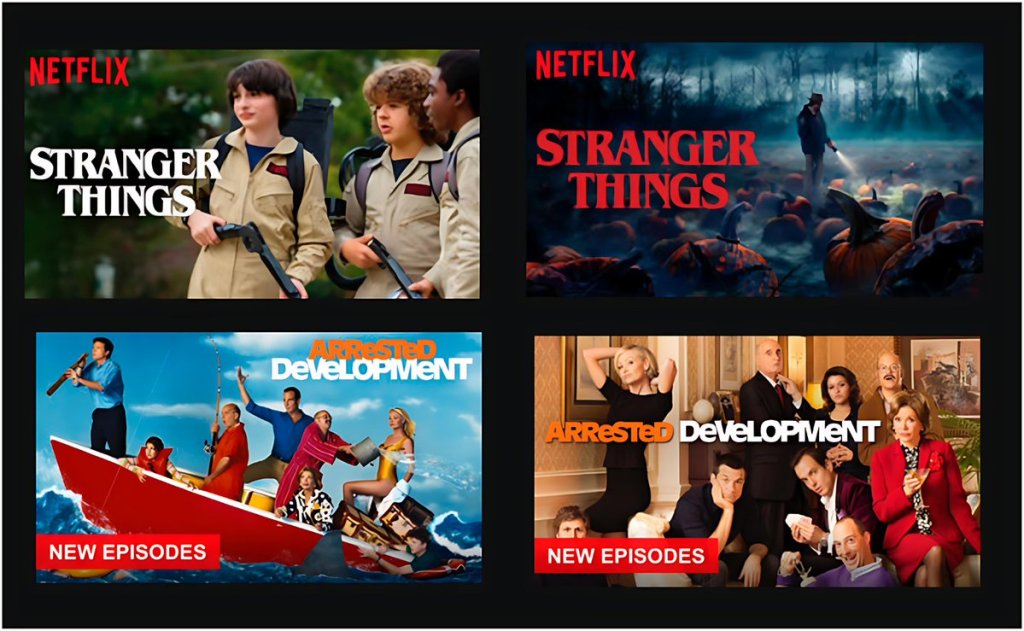
4/ It also gets more personal…
If you love comedies, the system will bias toward thumbnails with goofy faces or lighter color palettes. If you’re a thriller fan, you’ll see more intense, moody images. The artwork adapts to your click history. It’s not just regional targeting—it’s individualized persuasion, at scale.

5/ Same for your favorite actors
If you’re someone who’s watched a ton of Uma Thurman movies, Netflix is going to show you pulp fiction artwork featuring Uma. But if you’re a John Travolta fan, you’ll see him instead. The system is actively optimizing the artwork for your specific taste.

6/ The persuasion is also hyperlocal
The “winning” image in the us might totally flop in france, japan, or brazil. So netflix personalizes not just for individuals, but for entire cultures. “I am a Legend” had a different thumbnail in nearly every major market, reflecting local tastes, casting, and emotional cues.

I also discovered that they use computer vision to find the “focal point” of every image (usually a face, sometimes an object) so the thumbnail auto-crops perfectly for everything from a 4k tv to a phone in portrait mode. If there’s a “new episode” badge or a localized title, the system checks that it doesn’t cover a face or overlap with existing text.
Netflix built systems to track billions of impressions a day, across every device, locale, and session. They invented lineage ids for images, so they can connect different crops, color grades, and language overlays back to the same source. They log which variant you saw, on which screen, in which country, and what you did next.
The meta-lesson: attention is finite, and the best way to earn it is with relentless, data-driven iteration. Every pixel is tested, every outcome measured, every assumption on the table. Taste and ego are distractions; only the data matters.
